
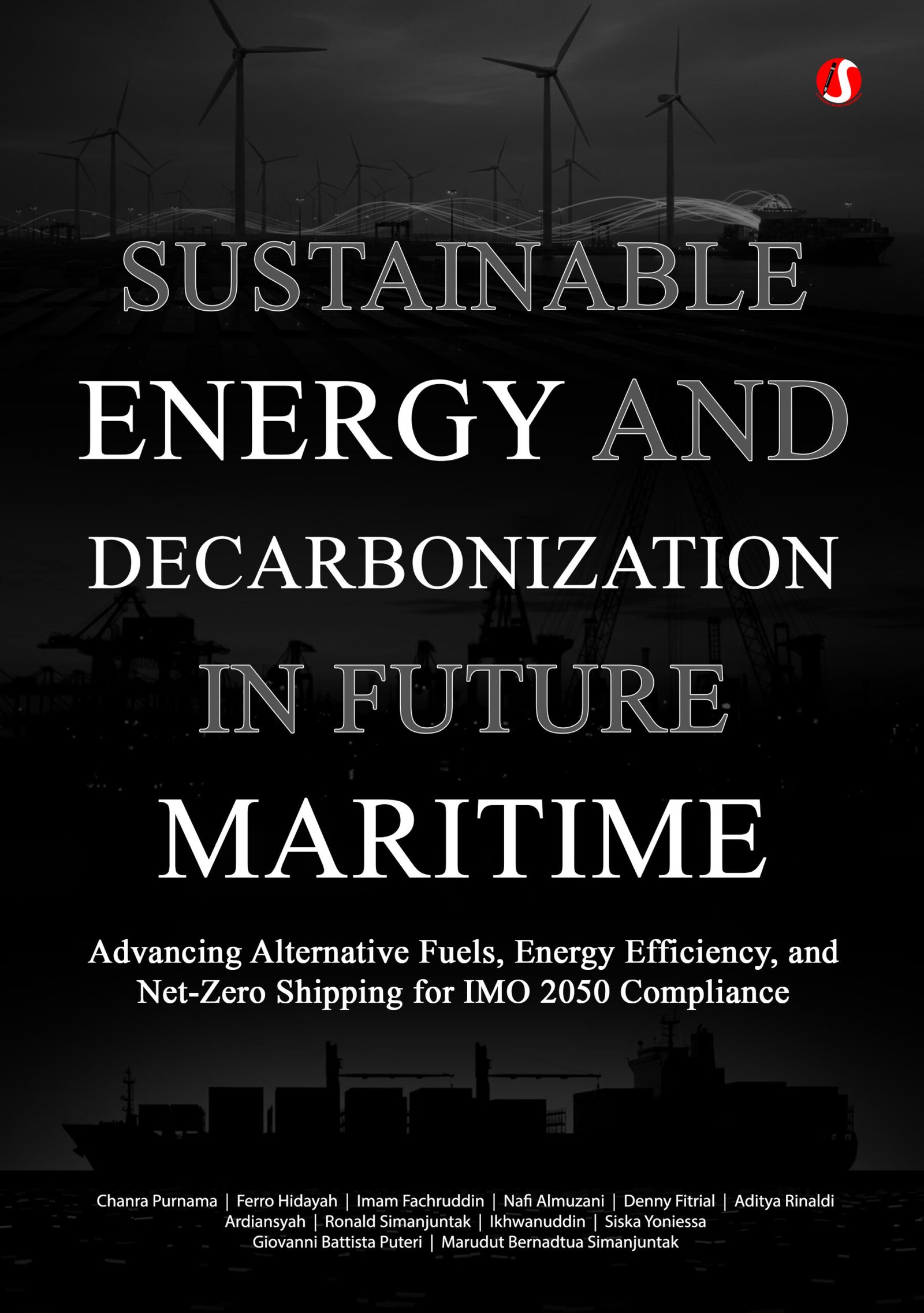
MARITIME MARKETING AND DIGITAL INNOVATION: Advancing Alternative Fuels, Energy Efficiency, and Net-Zero Shipping for IMO 2050 Compliance
Price: IDR 247,000
First Edition, February 2026
17,6 x 25 cm, xvi + 216 Pages
ISBN: …………………….
Authors :
Chanra Purnama
Ferro Hidayah
Imam Fachruddin
Nafi Almuzani
Denny Fitrial
Aditya Rinaldi
Ardiansyah
Ronald Simanjuntak
Ikhwanuddin
Siska Yoniessa
Giovanni Battista Puteri
Marudut Bernadtua Simanjuntak
Santika
Editors :
–
–
Desain Cover :
Riski Prahmana Putra
This book discusses :
This book presents a comprehensive discussion on energy transformation and decarbonization strategies in the future maritime industry as a response to global demands for cleaner, more efficient, and sustainable shipping. It elaborates on international regulatory frameworks, innovations in ship design and energy efficiency technologies, the utilization of transition fuels as well as zero-carbon fuels, and the integration of renewable energy and environmentally friendly port infrastructure. Furthermore, this book examines approaches to carbon intensity measurement and lifecycle assessment, economic aspects and investment frameworks for the green transition, as well as competency strengthening and human resource development to support the comprehensive implementation of decarbonization. With a strategic and practical approach, this book is expected to serve as an important reference for academics, practitioners, regulators, and stakeholders in realizing a low-emission and sustainable maritime future.
The following chapters will be discussed in this book :
Chapter 1: Imo 2050 Strategy and Global Decarbonization Framework
Chapter 2: Energy Efficiency Technologies and Ship Design Innovation
Chapter 3: Liquefied Natural Gas (LNG) And Bio-Lng as Transition Fuels
Chapter 4: Methanol and Bio-Methanol Marine Applications
Chapter 5: Ammonia – Zero-Carbon Fuel of The Future
Chapter 6: Hydrogen and Fuel Cell Technologies
Chapter 7: Battery Systems and Hybrid Propulsion
Chapter 8: Wind-Assisted Propulsion and Renewable Energy Integration
Chapter 9: Shore Power and Port Energy Infrastructure
Chapter 10: Carbon Intensity Indicator (CII) And Lifecycle Assessment
Chapter 11: Economic Analysis and Investment Frameworks for Green Transition
Chapter 12: Training, Competency, And Workforce Development for Decarbonized Shipping